Magnetometry is a commonly used technique allowing rapid mapping of archaeological objects, structures and features contained within the sub-soil which have become slightly magnetised by the Earth's magnetic field. The technique measures the difference between the magnetic fields around such features and those of the surrounding soil which are not normally very susceptible to becoming magnetised. Magnetometry is often used in archaeological investigations to detect silted ditches, hearths, in-filled pits, burnt or fired remains (e.g. a kiln), walls, ferrous metals and variations in soil and bedrock.
There are different types of equipment in use. By far the most frequent are fluxgate gradiometers, when the method is often described as magnetic gradiometry.
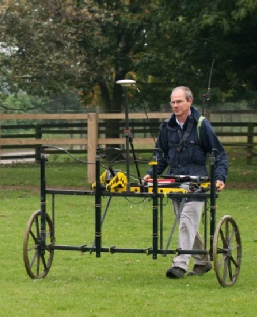
James Lyall operating a Foerster Ferex 4.032 DLG fluxgate gradiometer 4-probe array, mounted on a manually propelled cart, during a survey conducted for RRRA